
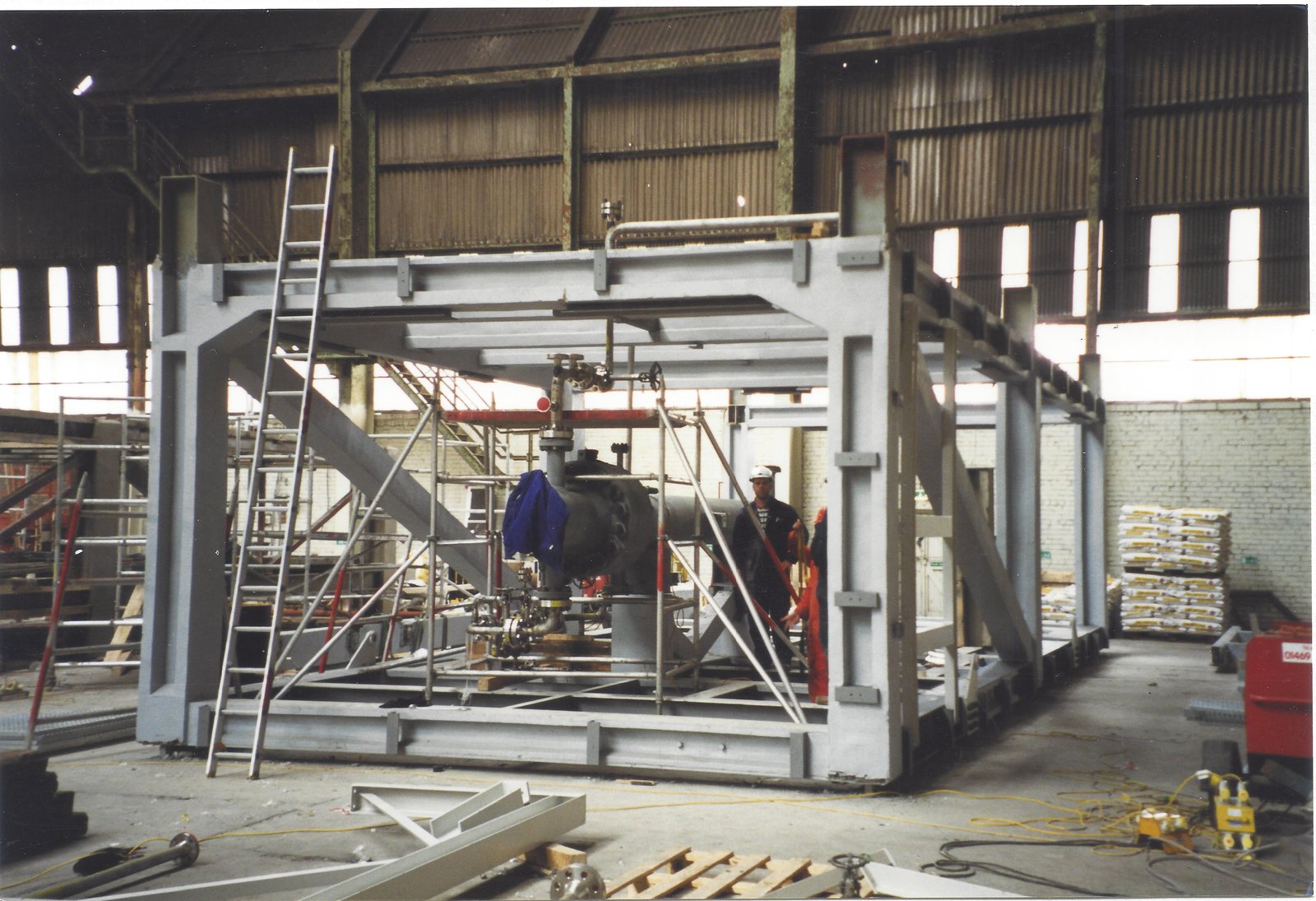
One of the strengths of Fendolite-MII is that it does not have to be applied on site. Beams, columns and whole modules can be coated under cover, left to cure, and then lifted, transported and erected with the fire protection already on. Only the connections are completed on site.
Why do it off site
- The work is done under cover, so it does not depend on the weather.
- Fire protection comes off the site programme and out of congested areas.
- Access is easier at working height in a workshop than on scaffold.
- Quality checks are simpler to carry out and record.
In the workshop
- Steel is blast cleaned to SA 2.5 and primed to the client specification.
- Sections are set out on stillages about 1,000 mm high so that all faces can be reached.
- Helical weld pins are fixed at a maximum 400 mm staggered pitch. No pins go on the underside or the exposed ends of beams.
- Areas that are not to be fireproofed, including the connection zones, are masked.
- PSK-101 is applied at 100 to 150 microns wet film thickness.
- Mesh is fixed to the pins and left protruding at least 2.5 mesh apertures beyond the Fendolite at each termination, ready to tie into the site joint.
- Fendolite-MII is sprayed to thickness, with a tolerance of 0 to +3 mm and a final coat of at least 8 mm.
- Topcoat 200 is applied in two coats, kept back 100 mm from the edges so the site joint can be matched in.
Curing, lifting and transport
Coated steel is stored under cover for at least seven days before it is handled or shipped, counting the day spraying finishes as day one. This lets the Fendolite reach full strength.
- Lift with flat reinforced webbing 100 mm wide, with brackets on the unprotected ends, or with forks on an unprotected flange.
- Carry sections on a flatbed, supported on timber bearers under their unprotected ends.
- Strap around the unprotected ends. If a strap must cross the Fendolite, pack between the strap and the coating.
Hook-up on site
- Check and clean the steel at the connection. If more than two months have passed since the PSK-101 was applied, apply a further coat.
- Tie new mesh to the mesh left protruding, with an overlap of two apertures at every join.
- Soak the edge of the existing Fendolite with clean water.
- Fill the joint with sprayed Fendolite-MII or trowelled Fendolite-TG, finished level with the existing coating.
- When the joint has cured and dried, apply the topcoat and then the mastic seal.