
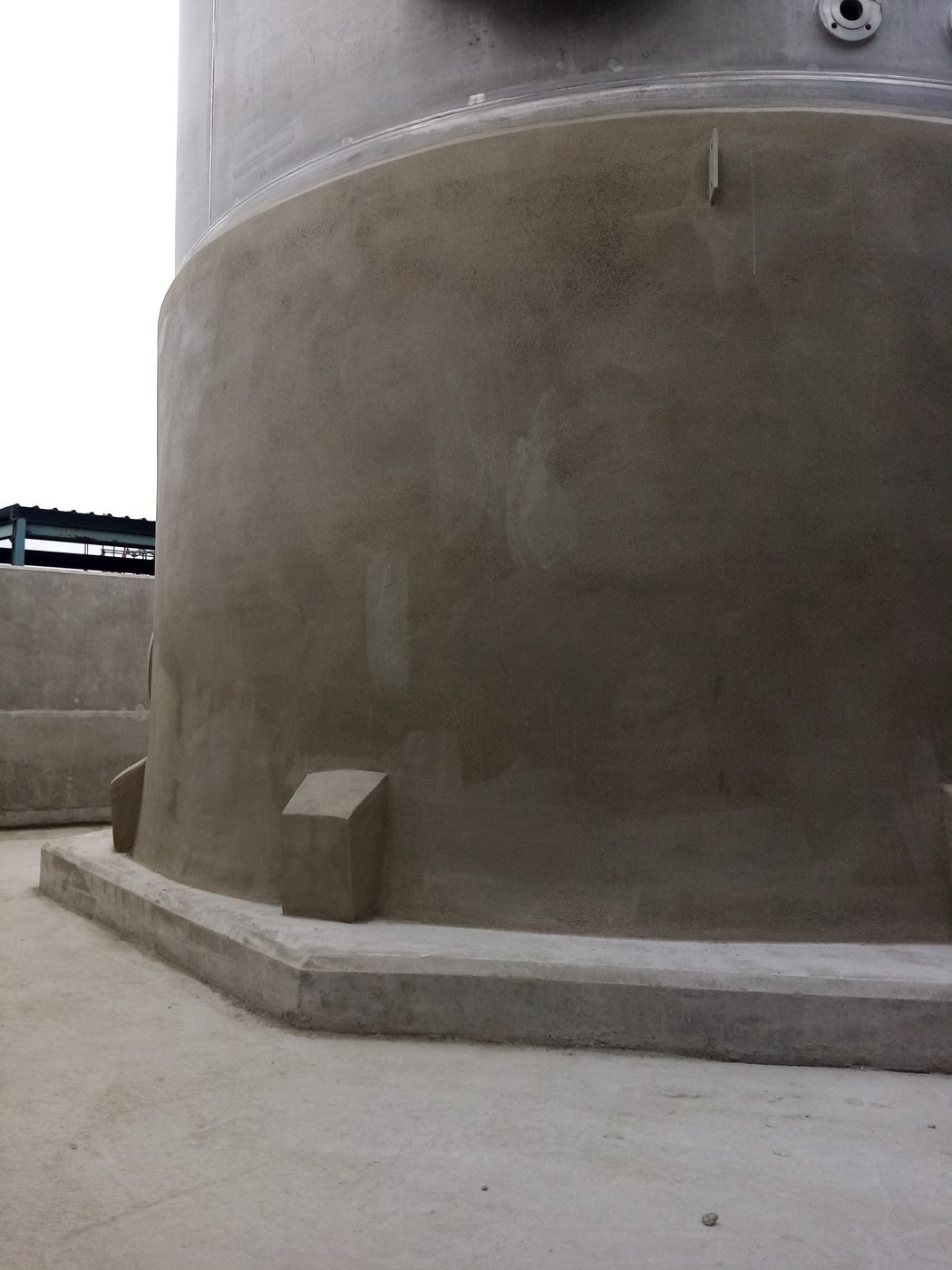
Promat class a vessel skirt as large when its inner or outer surface is more than 20 m². This guide covers large skirts running at up to 50°C. Both faces of the skirt normally need protection.
Which mesh
In both cases the mesh should sit in the middle third of the Fendolite thickness, not against the steel and not at the surface.
Build-up on a large skirt
- Pins or welded nuts, where welding is allowed, at a maximum 400 mm staggered pitch. Where it is not, adhesive pins can locate the mesh but must not be relied on in a fire.
- One coat of PSK-101 at 100 to 150 microns wet film thickness.
- A first layer of Fendolite-MII, slightly less than half the total thickness, left rough for at least 24 hours.
- Galvanised welded wire mesh, with two apertures of overlap at every joint and no more than three layers overlapping at any point.
- A second layer of Fendolite-MII to the specified thickness, with a final coat of at least 8 mm.
Water is the main threat to a skirt, so top surfaces and terminations are sloped to shed it. There are two kinds of mastic seal, and they do different jobs.
Seals at terminations and junctions
Where Fendolite-MII meets steel, bracket supports or rigid fixings, an 8 mm wide channel is cut into the material back to the steel and filled with polysulphide or silicone mastic. A mastic seal also goes where the Fendolite meets the concrete plinth, to stop standing water being absorbed.
The expansion joint at the manway
A mastic seal is applied around the manway. A further seal runs vertically over the full height of the skirt, above and below the manway, and acts as an expansion joint.
Promat recommend that the mastic seals are applied after the topcoat, not before.